JOURNEYS INTO THE NEW WORLD OF ECOVILLAGES
Regenerated Landscapes, Ancestral Values, and the Ethics of Restoration
A reflective essay on restoration, ancestral knowledge, and regenerative life
By Dr. Débora Nunes
Edited for Xenoloop web publication
Across five continents, one commitment appeared again and again in the communities we visited: the restoration of original biomes through the return of native fauna, flora, and soil microbiota. Wherever this work was taken seriously, the effects were visible. Water became more abundant. Biodiversity increased. The air felt cleaner. Microclimates became milder and more hospitable. In some places, territories once marked by aridity had, over decades of patient labour, been turned into forests. In others, the protection of springs and the creation of artificial lakes, later naturalized by time, had begun to transform locally dry climates into more humid and fertile environments.
Where does the determination for restoration on this scale come from? Part of the answer is plainly historical. The climate emergency now demands restorative action, and in ecovillages this has encouraged regenerative forms of behaviour. In ancestral communities, the same emergency often intensifies the struggle to defend the lands that sustain culture, memory, and life itself. But the answer is not only objective, as if restoration were simply the rational conclusion of environmental analysis. There are deeper motivations at work: emotional, ethical, and spiritual forces that lead certain communities to break from the inertia that grips so much of modern society, including those who know the scale of ecological collapse and yet remain unable to act.
At the emotional level, much of this impulse arises from a reconnection with the planet in the form of Mother Earth, an archetype that appears across civilizations. Pachamama among Andean peoples, Maka Ina among the Lakota of North America, Prithvi Mata in India, and Gaia in Greece are variations of a shared civilizational intuition: that the Earth is not inert matter but a living source that demands reverence and care. This emotional dimension is often inseparable from a spiritual one. Mother Earth is not merely symbolic. She is invoked as a sacred presence, and this understanding helps shape the ethical life of regenerative communities. One principle emerges with particular clarity: everything is connected, and each of us participates, whether consciously or not, in the making of collective futures.
In ecovillage culture, it is common to find the conviction that if life in its broadest sense is to be protected, then its source must also be protected and regenerated. Everyday gestures acquire the quality of ritual: eating food free from toxins, restoring soil through composting, purifying used water, consuming less, reusing what can be reused, and avoiding forms of waste that the Earth struggles to absorb, especially plastics and synthetic chemicals. From this same ethic arise local economies rooted in care: organic food production, biodegradable cosmetics and cleaning products, cotton clothing and reusable bags in place of synthetic materials, and many other goods that generate income while reinforcing ecological coherence.
One word appears constantly in these settings: permaculture. More than a technique, permaculture is a design ethic that combines traditional Indigenous land practices with contemporary ecological thinking. Its three foundational values, articulated by Bill Mollison and David Holmgren, are care for the Earth, care for people, and fair share. These values resonate strongly with ancestral philosophies of interdependence such as Sumak Kawsay and Suma Qamaña in the Andes, as well as Ubuntu in southern Africa. In practical terms, permaculture often appears in concentric or expanding zones of land use: an area of intensive daily use around the home, followed by agroforestry with fruits, vegetables, and herbs, then grains or animals, and finally more distant forested areas.
This logic extends beyond agriculture. The idea of a permanent culture encourages renewable energy, low-impact construction, water systems built around retention, infiltration, and storage, ecological sanitation with dry toilets, banana circles, evapotranspiration basins, and diverse composting methods. Ecovillage life and permaculture practice are closely intertwined, and from this relationship another important process often emerges: Community Supported Agriculture. Through CSA, producing communities and nearby consumers form direct relationships, negotiating prices, products, and delivery without intermediaries. The result is not only a stronger local economy but a more solidaristic and ecologically grounded one.
Those engaged in regeneration, much like ancestral peoples, tend to understand Nature as sacred. They do not see themselves as separate from it, but as expressions of it, and they seek to live in ways consistent with that conviction. This is also the basis of the environmental healing evoked by Ailton Krenak, the Brazilian Indigenous thinker whose work insists that if the future is not ancestral, it may not exist at all. Ecovillages, at their best, are attempts to build futures that remain possible. Their reconnection with ancestral knowledge is therefore not ornamental or nostalgic. It is foundational. To deepen this understanding, and to test the hypothesis that regeneration depends on such reconnection, it is worth travelling through some of the ancient wisdom traditions that sharply contrast with the dominant habits of Western modernity, a world so immersed in its own assumptions that it often fails to see how impossible its path has become.
Ancestral Wisdom and the New World
I share Krenak’s intuition, and I saw how strongly ecovillages resonate with it. If we are to move beyond the culture of fast food, hyper-consumption, and the appearance of success at any cost that sustains capitalism, we must reconnect with ancestral wisdom, with eras in which other values oriented human life. In those earlier worlds, Nature was still the great teacher. Human intervention was more limited, and people lived within environments that had not yet been radically transformed. In Taoism, for example, Nature offered the language through which the creative forces of the universe were understood: yin and yang, darkness and light, moon and sun, night and day, feminine and masculine. In Yoga, animals, landscapes, and plants inspired not only physical and breathing practices, but also ethical principles. In Sumak Kawsay, when human conduct is harmonized with community and Nature, life becomes full.
Another principle common to many ancestral traditions, and one deeply present in ecovillage life, is the recognition that each person bears responsibility for the harmony of the whole. This differs sharply from aspects of the dominant Western religious imagination, in which an all-powerful God defines sin and virtue from above and punishes accordingly. Many Indigenous and ancestral cosmologies are profoundly spiritual, but their foundations lie elsewhere: in the awareness that all things are connected and that life depends on reverence for this living mystery. In such traditions, to fall out of harmony is already to incur consequence. There is no need for an external punishing authority when life itself reveals the cost of imbalance.
To make this connection clearer, I will briefly revisit three traditions whose worldviews illuminate what we saw in regenerative communities: Yoga, Taoism, and Sumak Kawsay. Most ancestral traditions have been preserved through oral transmission and ritual continuity, but here I take as reference three bodies of thought that have also been articulated in written form: the Yoga Sutras of Patanjali, the Tao Te Ching associated with Lao Tzu1, and the contemporary systematization of Sumak Kawsay by the Aymara intellectual Fernando Huanacuni Mamani2. Though distant in geography, all three reveal ways of life in which regeneration is not an isolated environmental technique but a consequence of worldview.
Yoga
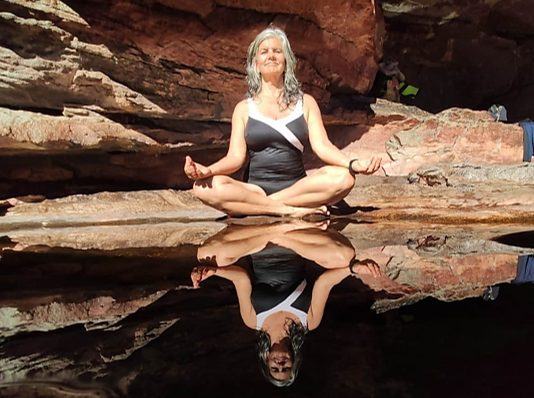
In Patanjali’s formulation, Yoga unfolds through eight limbs: Yama, Niyama, Asana, Pranayama, Pratyahara, Dharana, Dhyana, and Samadhi. Together they describe not only a discipline of the body and mind but a path toward integral well-being and the evolution of consciousness. Yoga assumes that physical, emotional, mental, and spiritual health are inseparable, and that care for one dimension affects the others, as well as the world in which one lives.
Nature is central to this vision. Its cycles, movements, and kingdoms are treated as sources of instruction. Yogic practice repeatedly invites the practitioner back into contact with the elements, with earth, water, air, and fire, and into attunement with the Sun and Moon, the seasons, the tides, day and night. At the heart of this relationship lies the idea of Prana, the vital force or cosmic energy that animates life and must be kept in balance for both personal and collective harmony.
The ecovillages we visited often embodied values that resonate deeply with Yoga: stillness, silence, simplicity, presence, and restraint. The five Yamas, ethical principles for social life, remain especially relevant: Ahimsa, or non-violence; Satya, truthfulness; Asteya, non-stealing; Brahmacharya, moderation in the use of vital energy; and Aparigraha, non-attachment. Read in contemporary terms, they offer a powerful critique of modern excess: violence, superficiality, exploitation, irresponsibility toward future generations, the commodification of desire, and unlimited consumption.
The Niyamas, which concern the inner life, can also be read as forms of resistance: purity instead of contamination, contentment instead of insatiable desire, disciplined effort instead of passive conformity, self-study instead of pseudo-spiritual distraction, and surrender to a higher order instead of narcissistic self-centredness. Even where ecovillage communities do not use explicitly yogic language, these orientations are often present in practice. They shape lives organized less around accumulation and more around coherence.
Taoism
Another ancestral tradition that strongly illuminates what we encountered is Taoism. Drawing on older Chinese wisdom and associated with Lao Tzu, the Tao Te Ching offers a concise but enduring meditation on how to live in accordance with the Tao, the Way of the Universe. At its heart lies a search for harmony: within the person, within society, and within every undertaking. That harmony depends on balancing yin and yang, receptivity and activity, contemplation and expansion.
From this follow other principles central to Taoist life: wu wei, action without forceful egoic interference; ziran, spontaneity and authenticity; and pu, simplicity, the shedding of unnecessary desires. Taoism cultivates serenity, self-restraint, and contemplation of Nature, and through them seeks what it calls the Three Jewels: compassion, moderation, and humility. These same qualities appeared repeatedly in the ecovillages we visited. Their commitment to peace, to moderation in daily life, and to the difficult work of humility all suggest an affinity with Taoist wisdom, even when the communities themselves do not name it as such.
Taoist thought also understands existence through dynamic patterns. The movement of the Tao, shaped by yin and yang, is expressed through five elemental processes: fire, water, earth, wood, and metal. These are not merely substances, but modes of movement that structure seasons, hours, emotions, tastes, sounds, and bodily processes. Health, in this framework, depends on balance among these interrelated movements. It is from this civilizational matrix that Traditional Chinese Medicine emerged, just as Ayurveda grew in relation to yogic thought.
Like Yoga, Taoism also recognizes a vital force, Chi, associated with breath and with the living circulation between body and cosmos. Duality, in this view, is not a tragedy but a source of movement, transformation, and return. Opposites are not enemies but complements. This principle is profoundly important for communities seeking regeneration, because it suggests that harmony is not achieved through domination or conflict but through balance, attentiveness, and right relation.
The Good Living: Sumak Kawsay and Suma Qamaña
The final tradition I wish to highlight is known in different forms as Buen Vivir, Bem Viver, Sumak Kawsay, or Suma Qamaña, an Indigenous Andean philosophy often translated as Good Living or Living Fully. Through both thought and political struggle, Andean peoples have shown that this tradition offers a real alternative to the catastrophic model of contemporary development. Their defence of the rights of Nature has been so powerful that such rights were incorporated into the constitutions of Ecuador and Bolivia. Rather than privileging GDP growth, individual accumulation, hyper-consumption, and life lived at dizzying speed, Good Living asks something much simpler and much deeper: how to live well with oneself, with others, and with Nature.
Its simplicity is transformative because it touches the meaning of life itself.3 To live well is not merely to possess more, but to cultivate balance. Drawing on the systematization proposed by Fernando Huanacuni Mamani, this search for balance can be understood through three broad domains: connection with Pachamama, inner balance, and wise relationship with others.
Connection with Pachamama begins with the most ordinary acts. It means knowing how to nourish oneself with what is healthy, seasonal, and local; understanding water as sacred and drinking with gratitude; dancing as a form of connection with earthly and cosmic energies; sleeping in attunement with natural cycles; and working with joy rather than alienation. Inner balance asks for meditative silence, thought guided by both mind and heart, and the capacity to love and be loved through respect for all that exists. In relation to others, Good Living teaches how to listen, how to speak constructively, how to dream a better reality into form, how to walk with the sense of being accompanied by protective and ancestral energies, and how to give and receive with blessing and gratitude.
What matters here is not the exoticism of the terminology, but the coherence of the worldview. Life is relational. Nothing exists in isolation. The sacred is not removed from daily experience but woven through food, work, speech, movement, sleep, and exchange. For this reason, Good Living remains one of the clearest ancestral expressions of what regenerative communities are trying, with difficulty but sincerity, to recover.
Ecovillages and Wisdom
Yoga, Taoism, and Good Living all understand the world as a vast web of interdependence in which touching one point means touching the whole. In each of them, community matters, common goods matter, and the long passage of life matters. Water, air, ritual, memory, and culture are not secondary concerns. They are part of what gives life meaning. Once the world is seen in this way, the regeneration of Nature ceases to be an optional environmental programme and becomes a natural consequence of how one inhabits reality.
What we witnessed in ecovillages was, again and again, a search for the essential. Sometimes this appeared in simple daily practices, sometimes in explicit spiritual language, sometimes in forms of ecological design, and sometimes in shared economies organized around care. But beneath the variety there was a common orientation: less can be more; simplicity can be a path; and fulfilment need not depend on endless accumulation. These communities function, in this sense, as laboratories for new ways of living, though many of the values they recover are in fact very old.
Such choices tend to produce regenerative effects both for people and for landscapes. Nature responds to care with renewed exuberance. This is what we saw. And it is why I believe that, through these experiments and through many other converging efforts across the world, we may already be participating, however imperfectly, in the construction of an Age of Regeneration.
Notes and References
- Scholars of these texts affirm that, like the Bible and other ancient works, they systematize knowledge firmly rooted in the cultures in which they emerged and are not, as they may seem at first glance, wholly original creations. This in no way diminishes their merits; it helps explain why they continue to be cited whenever these traditions are discussed.
- Huanacuni Mamani, Fernando. Vivir Bien/Buen Vivir: Philosophy, Policies, Strategies and Experiences of Ancestral Villages. La Paz: International Institute of Integration, 2010.
- The concept of Buen Vivir becomes political when its logic extends to the economic system, which must be community-based and guided by solidarity, reciprocity, and co-responsibility. This is only possible through full participation and shared decision-making. By incorporating Buen Vivir into the constitutions of Ecuador and Bolivia, a new principle entered constitutional thought: the rights of Nature, in which humans are not the most important element but one link in the web of life.