
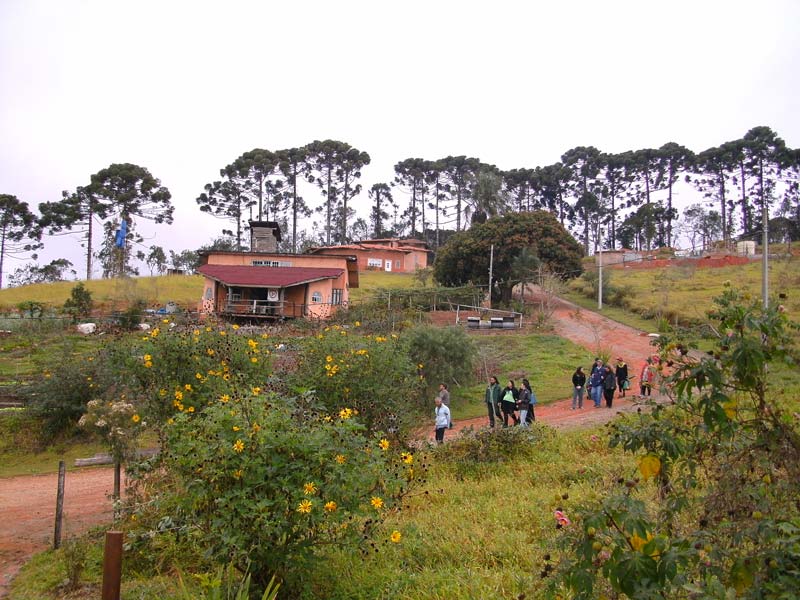
Regeneration, collective life, and intentional communities as living laboratories
Dr. Débora Nunes | Integral Ecology School (ESI)
Abstract
Drawn from years of travel, repeated visits, and sustained conversations, this essay is both testimony and gratitude. We write from the road, from gardens, kitchens, meeting circles, workshops, schools, temples, forests, and water systems that we encountered across intentional communities, ecovillages, indigenous territories, regenerative farms, and allied spaces on five continents. What we saw was not a finished model of salvation, nor a romantic escape from history, but a dispersed and stubborn effort to live differently: to regenerate land, reduce consumption, share resources, deepen democracy, honour the sacredness of nature, and confront conflict without surrendering to the social logic of competition, isolation, and endless accumulation. This essay offers a guided passage through those observations. It reflects on the restoration of ecosystems, collective infrastructures, communal production, culture and education, feminist and spiritual transformation, and the difficult art of self-governance. Above all, it argues that these communities should be seen as living laboratories of another civilization—imperfect, contradictory, vulnerable, and yet indispensable in a time of planetary and social unraveling.
Keywords: ecovillages; intentional communities; regeneration; self-management; communal life; permaculture; ecological transition; sacred ecology
Opening the Journey
This text opens a series on community-based alternatives to the many-layered collapse now unfolding across the Earth. It grows out of research on ecovillages, but even more from a deep personal commitment. Beyond published texts and long stays in Auroville in India, my husband and I have spent two decades visiting places that attempt, in different ways, to step outside the society that manufactures collapse.
Alongside ecovillages, we have travelled through other kinds of eco-places: intentional communities, indigenous territories, regenerative farms, and camps of the Landless Workers’ Movement. In all of them we encountered efforts—sometimes fragile, sometimes astonishingly mature—to regenerate damaged environments, build collective life, practice self-management, simplify material existence, and recover a sacred relationship with nature.
Over the last three years, our project ‘Visiting the New World’ has taken to the road in a more systematic way. We have travelled more than 50,000 kilometres across about twenty countries and documented nearly fifty communities with photographs and video. They are not identical, and they do not pretend to be. But they share something unmistakable: they are laboratories in which people are trying to live against the current of consumerism, competition, concentration of power, and alienation.
In this first essay, we want to guide the reader through a community that condenses much of what we have seen, while also drawing examples from nearly forty places across five continents. In the texts that follow, we will linger over particular themes as if we were continuing a conversation after watching a powerful film together. Before beginning that tour, however, it is worth saying briefly what we mean here by ecovillages.
Ecovillages are small and large communities—from around ten people to several thousand—living in self-managed ways and striving for sustainability, usually in rural settings but not exclusively so. They have expanded across the world and saw a notable post-pandemic surge, as many people began looking for ways to live differently and, quite literally, to get their hands dirty in the founding of new places. Counting them is difficult. GEN, the Global Ecovillage Network, has spoken of around 6,000 established ecovillages worldwide, though earlier estimates were higher, and anyone who has travelled through these worlds knows that many communities remain outside formal networks. The phenomenon gained wider force in the 1960s and was recognised by the United Nations in 1998 as one of the world’s hundred best practices in sustainable development.
Among the ecovillages that left the deepest impression on us are Auroville in India, the largest; Findhorn in Scotland, one of the oldest and most influential; Damanhur in Italy, with its artistic and spiritual intensity; Sainte Camelle in France, intimate and warm; Piracanga in Brazil, built with considerable resources and tropical charisma; and Crystal Waters in Australia, a landmark of permaculture. Yet the point of this essay is not to rank them. It is to ask what becomes visible when one approaches places that are trying, however imperfectly, to rehearse another form of life.
What Becomes Visible in the “New World”
The first thing that strikes us on arriving at an alternative community is often the vitality of nature itself. Again and again we have entered places where pioneers spent decades turning dry, degraded, or exhausted land into forest. Auroville is perhaps the most famous example, but it is far from the only one. Across continents we saw biodiversity return, forested areas expand, protected zones emerge, water reappear, and air remain clean even in urban or peri-urban communities such as Ecovila Maria in Brazil or Christiania in Denmark.
These transformations are not accidental. They are the result of a culture of regeneration that appeared, with local variations, in every eco-place we visited. Reconnection with Mother Earth is not treated as rhetoric there. It is practiced daily through choices about food, materials, waste, water, and labour. Communities restore fertility to the soil, refuse the chemicals that poison it, and put organic waste back to work. Permaculture—the culture of permanence—offers one of the strongest common languages across these places, not as doctrine but as habit: an effort to see cycles, relations, and wholes.
This is visible in bioconstruction, dry toilets, composting systems, recycling infrastructures, and experiments inspired by indigenous techniques such as the reinterpretation of Amazonian Terra Preta at Sítio do Futuro in Brazil. Food production is present almost everywhere, though in different degrees. At Chacra Rizoma in Argentina it is the main economic activity. At Chant des Cailles in Belgium it serves as a central social glue. Agroforestry systems of fruits, vegetables, herbs, and medicinal plants are widespread, whether at Ferme du Bec Hellouin in France or Aldeia do Altiplano in Brazil, where systems such as community-supported agriculture also connect growers directly with those who eat what is produced.
Water, too, is treated differently in these places. In the regeneration of damaged landscapes, communities learn to retain, produce, and cleanse water. At Findhorn in Scotland we saw this clearly. At Tamera in Portugal, lakes are not merely beautiful; they are ecological and social infrastructures. Elsewhere, water-harvesting ditches, reservoirs, spring protection, and careful storage systems enable communities to endure droughts with greater resilience. Native species are prioritised in reforestation. Gardens are cultivated everywhere, from Instituto Terra in Brazil to Eco Truly Park in Peru. Again and again we saw a conviction that nature is not external to us. We are nature. That perception—so alive in the indigenous communities we visited, from Mapuche territory in Patagonia to the Paiter Suruí in the Brazilian Amazon—appears to be one of the deepest sources of environmental healing in the alternative communities we encountered.
The second great difference between this emerging world and the old individualistic one is the palpable existence of community. It takes material form in shared spaces of dwelling, work, food, culture, decision-making, and technical infrastructure. At Longo Maï in France, even the economy itself is largely shared, and what astonishes is not only the model but its durability and the seriousness of commitment required to sustain it. Across the places we visited, infrastructures were often collective and built with significantly lower ecological impact than those of conventional society: solar, wind, geothermal and micro-hydroelectric systems; earth roads or soil-cement roads; interlocking blocks; rainwater harvesting; community-managed water systems without chemicals; and reservoirs designed to carry communities through increasingly unstable climates, as at Alto Lindo in Brazil.
Some innovations point toward future possibilities not yet fully realised. In Auroville and at Sítio do Futuro, for example, we encountered early efforts to produce ecological fuels that might one day loosen dependence on petroleum. Whether or not all such experiments mature, they reveal a practical desire for autonomy rather than mere critique of the existing order.
Shared Kitchens, Work, and the Material Life of Community
Community kitchens and dining halls are among the most powerful social spaces in these places. Most ecovillages we visited are vegetarian, a choice linked both to ecological commitment and to compassion toward animals. The forms of management vary, but shared labour is common: people rotate through the preparation of meals, often with ingredients grown nearby or directly on site. At ZEGG in Germany the food is abundant, organic, and deeply integrated into the life of the place. Dining halls become more than service spaces; they are centres of encounter, affection, conversation, and everyday democracy. The shared meal nourishes the body, lowers the cost of living, and strengthens the fact of living together.
It is difficult to single out one community kitchen because so many remain in our memory. Yet some are unforgettable: the vast kitchen in Auroville, capable of serving around two thousand meals in a day, and the open-air summer kitchen at Sainte Camelle in France, where conviviality seems to gather around the meal itself like a seasonal ritual.
Collective production spaces are also common. Tools, equipment, and supplies are often held in common, and the kinds of goods produced depend on the community’s economic vocation. We saw handicrafts of many kinds, small-scale agro-industries making olive oil, cheeses, and wholegrain bread, as at Los Portales in Spain; medicines and cosmetics made from local ingredients at Chambalabamba in Ecuador; honey, jams, and preserved fruits at Permatopia in Denmark; and even forms of small-scale industry based on metal recycling at Songhai in Benin. There are carpentry workshops, joinery spaces, bicycle and vehicle repair sheds, metalwork areas, and places dedicated to the circulation of used goods.
This practical economy of shared production matters for several reasons at once. It increases autonomy, generates income, lowers costs, extends the life of materials, and keeps consumption relatively low. But it also expresses a different philosophy of work—one that tries to reconnect labour, use, repair, and necessity. In a world organised around disposability, these spaces quietly defend permanence.
Art, Education, and the Beauty of an Alternative Civilization
A third element that stood out wherever we travelled was the importance given to art, culture, and education. The old world, for all its obsession with growth and property, rarely gives these dimensions the place they deserve. Many of the communities we visited, by contrast, draw a substantial part of their livelihood from teaching the very practices through which they live: permaculture, bioconstruction, methods of collective governance, alternative therapies, and integrated experiences that bring many of these things together. At Glarisegg in Switzerland, the educational infrastructure is exceptionally well equipped. At Piracanga in Brazil, course participants are received in beautifully built tropical lodgings. At the Contestado encampment of the Landless Workers’ Movement in Brazil, an international school of agroecology anchors a wider political and pedagogical horizon.
What surprised us again and again was the scale and ambition of cultural infrastructure in places with only a few dozen or a few hundred inhabitants. Fazenda Plenitude in Brazil, Matavenero in Spain, and Chambalabamba in Ecuador all offer striking examples of this. In Chambalabamba, where artists were central to the life of the community, an open-air theatre became one of the place’s most memorable points of gathering. Performances, often free, draw people from outside the region in communities such as Auroville and Findhorn.
Art is not decorative in these places. It is woven into everyday life. At Arca Verde in Brazil, beauty appears in the bio-architecture of the houses, the communal spaces, and even the signage. Damanhur’s Temple of Humanity is overwhelming in both scale and vision. At El Nagual in Brazil, mosaics leave a bright and lasting mark on memory. There are places built for celebration, dance, flirtation, and joy, such as Tamera and ZEGG. At Crystal Waters in Australia, a musical plaza with giant instruments open to anyone who wishes to play becomes a public invitation to wonder. At Terra Una in Brazil, artistic residencies help link creation to the regeneration of nature. Taken together, these places suggest that another civilization would not be made only of efficient systems and clean technologies. It would also have to be beautiful.
Sobriety, the Feminine, and the Sacred
A fourth striking characteristic of this ‘new world’ is low consumption. This simplicity is not merely the result of financial constraint, though in some communities resources are certainly limited. More often it is an ideological and ethical choice: an attempt to pursue what some call a happy sobriety. This choice becomes visible in built space, in clothing, in the scale of dwellings, in the way goods circulate, and in the refusal to equate abundance with accumulation.
To reduce ecological footprints, many facilities are held collectively and many services are shared. Communal laundries, shared bathrooms and saunas, dining halls, repair spaces, and free stores for used items are common. Clothing, furniture, appliances, tools, and utensils move from hand to hand rather than being trapped in the logic of private possession. This circulation is practical, but it also changes the emotional texture of material life. Things become less about identity and more about use.
The fifth theme that stood out to us was the cultivation of the feminine and of a secular, non-dogmatic spirituality. Every community approaches patriarchy differently—through political forms, sexuality, economics, ritual, language, or everyday behaviour—but across many of these places we lived in environments with significantly greater gender equality and with women occupying the positions of presence and political weight that the old world so often denies them. In some of these communities, men cry, speak more softly, give up the need to dominate discussion, and allow other forms of strength to emerge. In places like Terramirim in Brazil, one also sees a more natural flourishing of non-binary behaviours and greater openness to affective, emotional, and sexual experimentation.
At the same time, we found that spaces for the sacred were nearly always present. Often they were immersed in nature, like the open-air shamanic temple at Cabrum in Portugal. Elsewhere they took monumental or highly symbolic form, as in the Matrimandir at Auroville or the ‘truly’-shaped structures of Eco Truly Park in Peru. This spirituality is generally not confessional. It is ecumenical, integrative, and rooted in an expanded sense of reality as matter, energy, relation, and vibration. Thoughts, emotions, atmosphere, subtle perception, and the felt interdependence of all beings are taken seriously. These communities are not merely trying to organise property differently; many are trying to relearn how to inhabit the world as a unified field rather than as a collection of separable things.
The Hard Work of Self-Management
The sixth theme, and in some ways the one that gathers all the others, is the search for self-managed life: the difficult art of collective governance. In every community we visited, we either witnessed or heard about recent meetings in which people struggled to remain together, revise agreements, solve problems, and continue evolving. Nearly everywhere, there are co-authored documents that crystallise the history of the collective project—texts that are revised over years or decades and that testify both to aspiration and to the labour of staying with one another. The material infrastructures of these communities are also records of governance: they exist because people were able, at least for a time, to decide together, invest together, and persist together.
For participatory governance to function, however, technical procedures are not enough. One of the deepest characteristics we saw in the people who remain in these communities is a willingness to undergo personal transformation so that conflict can be endured and worked through rather than allowed to destroy everything. Self-knowledge matters. So do apology, forgiveness, patience, and the courage to face ego, impulsiveness, resentment, and misunderstanding without turning them into destiny. If we had to choose a single image to represent the ‘new world’ we visited, it might well be the discussion circle: outdoors or indoors, in ritual, in argument, in voting, in silence, in deep listening. There the community’s fate is negotiated again and again.
To the Founders and Keepers of These Dreams
When we think of the people who founded and sustained these places, what we feel first is gratitude. These laboratories of a new humanity, with all their daily inventions and fragile achievements, would not exist without the courage of those who dared to begin them. To thank them is not a courtesy. It is a necessity.
These are people who moved beyond critique and complaint. They did not stop at identifying the sickness of the world. They tried to build something else. In that sense, they took Gandhi’s oft-repeated challenge seriously: to become what one wishes to see in the world. They accepted responsibility, rolled up their sleeves, and worked with their own hands. In a society that so often demands change from others while refusing transformation in personal and local life, this is an unusually adult and demanding stance.
The communities we have visited live against the dominant current of consumerism, competition, concentration of power, and alienation. For that alone they deserve admiration. But there is more. They also expose the poverty of those who criticise the system while remaining complacent in their own conduct. Of course there are people who fight politically against injustice, and their struggle matters enormously. Yet the people we encountered through the ‘Visiting the New World’ project often go one step further: they feel called to build, not only to denounce. They are trying to give form to a future that can be inhabited.
Because we have also seen many similar initiatives collapse or quietly disappear, we recognise persistence itself as heroic. To continue is not simple. It demands honesty and humility in the face of failure, but also confidence deep enough to withstand internal crises and external pressure. This coexistence of humility and confidence is rare, and where it is present one feels the moral stature of the people involved.
Another quality that stood out to us was authenticity. In a world increasingly built around display—false smiles, artificial beauty, exaggerated success, and endless self-presentation—the sincerity we encountered in these communities was a relief. In interviews and conversations, again and again, we felt that people were trying to speak truthfully about what had worked, what had failed, and what still remained unresolved. Their honesty gave their achievements greater dignity, not less.
Democracy, Contradiction, and the Laboratory of the Future
We owe these communities a special thanks for what they are inventing in the field of everyday democracy. There is so much experimentation here, so much trial and error, so many attempts to build forms of power-sharing that do not simply reproduce the pathologies of the societies from which these people came. Sociocracy, among other methods, appears often. But beyond names and systems, what matters is the willingness to ask difficult questions: does gender create privilege? Does age? Nationality? Eloquence? Education? Emotional confidence? The communities we visited were often trying to identify forms of inequality more subtle than income or schooling, because they understood that participation only becomes real when hidden asymmetries are named and worked on.
For us, these places are helping to build the participatory democracy of tomorrow: more competent, more inclusive, and more rooted in lived experience. That does not mean the work is free of frustration. On the contrary, governance is often one of the greatest sources of exhaustion in these communities. But healthy democracy is itself one of humanity’s greatest ambitions. We should not expect perfect satisfaction in a few decades after millennia of authoritarian life and deeply internalised hierarchies.
We also wrote this text because, in conversation after conversation, we noticed a recurring disappointment among community members when they compared their original project with current reality. This is understandable. Utopia, as Eduardo Galeano wrote, is always on the horizon. Yet in times marked by the rise of authoritarian and destructive political forces, to celebrate alternative communities is also to defend a generous and humanist political imagination. These people may not feel triumphant. They are too close to the daily labour and contradiction of what they are building. But from the outside, one sees something they may sometimes forget: continuity itself is a magnificent achievement. Persistence makes hope concrete.
Living Laboratories in a World in Collapse
For this reason, we propose that intentional communities be understood more consciously as research laboratories. How were the discoveries made that freed humanity from so much physical pain and disease? In laboratories: through persistence, failed attempts, revised hypotheses, and the stubborn defence of a fragile flame of hope. These communities, in their own way, are laboratories seeking the healing of the human heart and soul. They pursue healthier bodies through simpler habits, natural therapies, contact with the land, and different rhythms of life. But they also venture into more difficult terrain: the wounds generated by human relationships, domination, fear, loneliness, and spiritual separation.
What we witnessed, despite all the differences among these places, was a laboratory spirit. People allow themselves to become participants in the experiment. Theories fail in practice. Contradictions emerge. Initial points of view are revised. Communities expose themselves to circles, forums, confrontations, rituals, tears, forgiveness, and rearrangement. They know that others mirror one’s own contradictions, and that collective life strips away many comfortable masks.
Meanwhile, the wider world—even among its wealthiest and most educated sectors—continues to identify enemies outside itself and to drift toward the ultimate madness of preparing for war. The alternative communities we visited often begin from a different premise: the deepest enemy, or perhaps the deepest teacher, is within. In that sense, healing begins inside persons and relationships before it can radiate outward into structures. Their philosophy, whether holistic, systemic, ancestral, or simply intuitive, insists that inner and outer life are not separate.
This does not mean withdrawal from social struggle. Many of these communities are pacifist and also committed to wider emancipatory causes. They fight, in their own ways, for those most damaged by the system, and above all for the living world itself—for nature and for its feminine fibre, giver of life. Yet they must balance combat and pacification, authenticity and diplomacy, internal work and external alliance. This is not easy. The outside world often regards them with suspicion and sometimes hostility because they are subversive examples in the deepest sense: they disturb, unsettle, and make others question themselves.
Some communities are criticised for becoming bubbles. Sometimes that criticism is fair; often it is simplistic. To remain open to the surrounding world while preserving a different civilizational logic is extraordinarily difficult. Let anyone who has mastered that balance cast the first stone.
Generations, Transmission, and the Need to Continue
A contradiction that many communities now face could hardly have been foreseen by their founders: the challenge posed by new generations to what earlier generations created. Time passes. Children grow. Young people arrive. They are enchanted by the possibility of another world, but because they did not begin from absolute scarcity, they often see the contradictions of the founding generation with unusual sharpness. Their demands for coherence can be stronger, more radical, and less patient.
This generational tension is not unique to alternative communities. It is part of life itself. But in these places it is intensified because the dream is explicit, shared, and continuously evaluated. Without rituals of transmission, the energy of renewal can become destructive or simply sorrowful. We sensed, in many cases, the pain of elders who felt questioned without respite and the impatience of younger people who did not want the original rebellion to become institutional routine.
It seems to us that both generations have responsibilities here. The younger generation must recognise the gift it received from those who built the infrastructure, social fabric, and possibility it now inhabits. The founding generation, meanwhile, must understand that the dream will not remain alive unless younger people truly feel invited into it. Rituals, reverence, criticism, gratitude, courage, and patience all have a place in this transmission. If shamans, healers, and elders are needed to help guide it, then let them be called.
May the examples we have witnessed encourage many more people—young and old, of every belief and every colour—to launch themselves, with their own strength, toward a new world, or rather toward new worlds. This old one is breaking apart before our eyes, and it urgently needs to be surpassed.
Version history
Version 1.0 — Xenoloop manuscript edition prepared from the submitted translation and revised into a polished author-voice publication format.