
In 1772, the modern credit system experienced one of its earliest and most revealing moments of stress.
Long before the creation of central banks, financial regulation, deposit insurance, or the idea of institutions being “too big to fail,” the expanding credit networks of eighteenth-century London were already supporting global trade, merchant finance, and speculative investment.
For decades, these systems appeared stable. Credit instruments circulated widely, merchants relied on bills of exchange, and financial reputations often mattered more than physical reserves of gold or silver.
But in the summer of 1772, confidence began to fracture.
Across London’s banking houses, paper promises that had once been accepted without question suddenly became uncertain. Merchants demanded settlement. Partnerships collapsed. Payment chains stalled. What began as the failure of a prominent banking house quickly spread through interconnected credit networks.
The result was not simply a market downturn.
It was one of the earliest documented examples of financial contagion within a modern credit-based economy.
The First Credit Panic
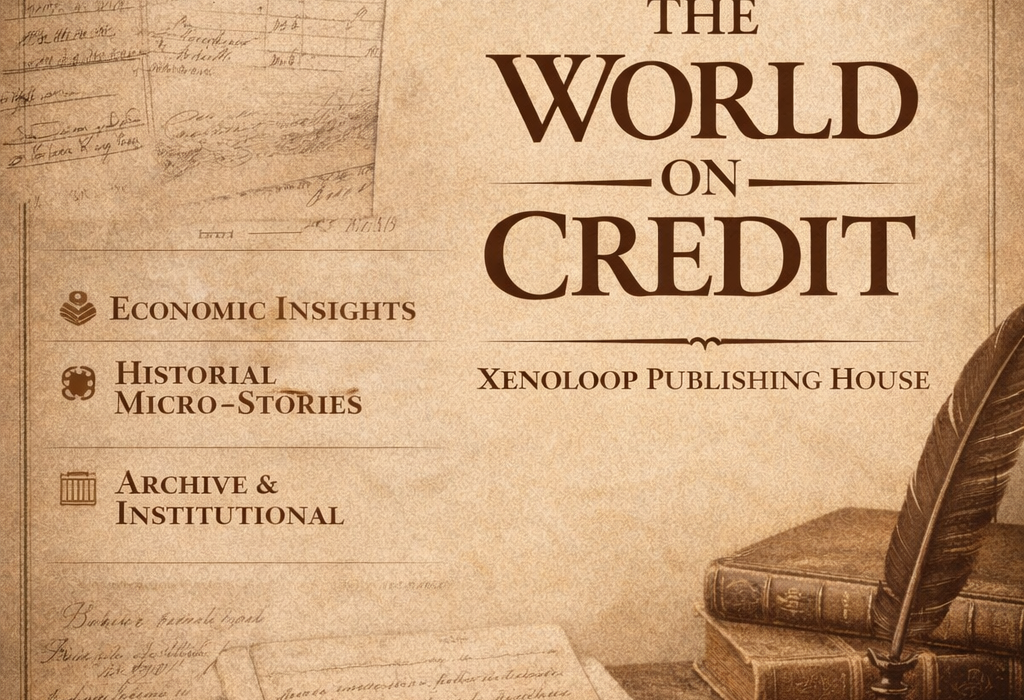
The World on Credit: 1772 — The First Credit Panic, published by Xenoloop Publishing House, explores this moment in financial history through narrative reconstruction and archival analysis.
The book examines how expanding financial networks created both prosperity and vulnerability. Credit allowed merchants to finance cargo that had not yet reached port and enabled traders to convert future earnings into present capital. But these same structures also made the financial system dependent on a fragile resource:
confidence.
When confidence disappears, liquidity often follows.
The panic of 1772 illustrates how interconnected credit relationships can transform a local financial failure into a broader systemic shock.
Economic Insights from Historical Financial Crises
Through the World on Credit platform, Xenoloop Publishing House explores the deeper economic lessons embedded within historical financial events.
Our research and content focus on:
• Short economic insights drawn from primary historical events
• Historical micro-stories illustrating key moments in financial crises
• Archive-style document reconstructions based on period records
• Institutional analysis and historical perspectives on finance
Rather than treating economic history as distant academic material, these explorations highlight how the foundations of modern financial systems were shaped during moments of uncertainty and systemic stress.
Credit, Trust, and Financial Systems
At its core, the story of the 1772 crisis reveals a simple but powerful principle.
Credit is not simply a financial instrument.
It is a network of trust.
When confidence weakens, financial structures built upon that trust begin to tremble. Markets that once appeared stable can quickly become fragile.
The financial panic of 1772 shows how belief, reputation, and institutional relationships functioned as the true infrastructure of early credit markets.
Understanding these dynamics helps explain why financial crises—past and present—often follow similar patterns.
A Narrative Exploration of Financial History
The World on Credit series examines the history of global finance through the moments when credit systems came under strain.
Beginning with the 1772 financial panic in London, the series explores how crises reveal the inner workings of economic institutions, market structures, and financial networks.
These stories remind us that modern financial systems did not emerge fully formed. They evolved through experimentation, expansion, and moments of collapse.
Follow the Archive
At Xenoloop Publishing House, we continue to explore the intersections of financial history, economic systems, and institutional development.
Follow our work for:
• Research-driven insights into economic history
• Archival explorations of financial crises
• Narrative reconstructions of pivotal historical events
• Analysis of how credit systems shaped the modern global economy
Because credit is not currency.
It is confidence.
And confidence always leaves a record.